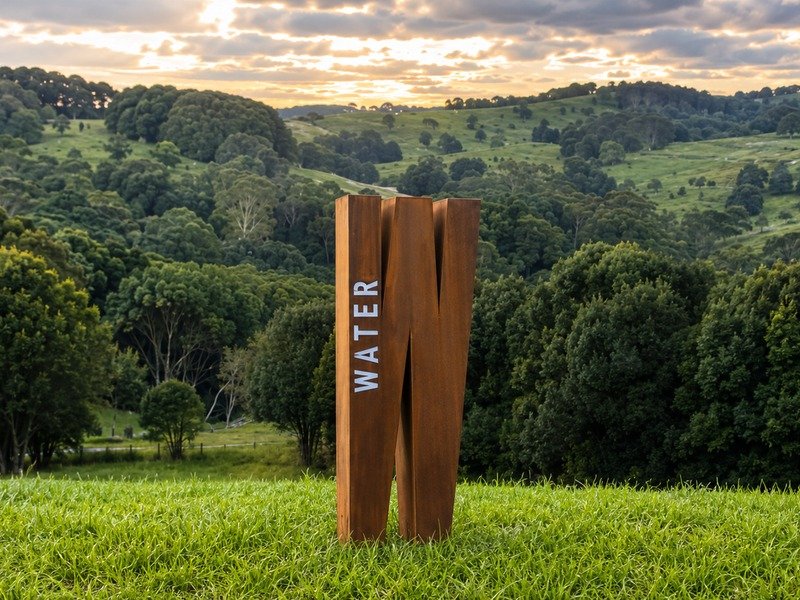
Corten Steel in Bushfire Zones in Australia

Corten steel is non-combustible in a bushfire zone, but no fence is fireproof. In Canberra in 2003, ember attack alone or with radiant heat accounted for 85 percent of house losses, and AS 3959 sets 6 Bushfire Attack Levels, from BAL LOW to BAL FZ, with radiant heat running from less than 12.5 to more than 40 kilowatts per square metre.
That is the honest start. We build corten steel fences, gates and cladding in Byron Bay, and we supply Australia wide, so we say the limit first and the benefit second.
In this guide
- Is Corten Steel Non Combustible in a Bushfire
- What Your BAL Actually Controls and What It Does Not
- Why Embers Decide Whether a House Survives
- What the NSW 6 Metre Rule Means for Your Fence and Gate
- Solid Corten Panels and Ember Attack
- Why a Laser Cut Corten Screen Is Not a Bushfire Barrier
- Corten Gates in Bushfire Zones
- Corten Cladding on a Bushfire Prone House
- Where Corten Does Not Help in a Bushfire
- Corten on a Coastal Bush Block
- How to Find Your BAL Before You Order
- What to Ask Us Before You Order a Corten Fence for a Bushfire Zone
Is Corten Steel Non Combustible in a Bushfire
Corten steel is non-combustible, because steel passes AS 1530.1, and corten steel is steel. A non-combustible fence cannot catch fire and carry flame to your house. Non-combustible does not mean fireproof, because fire resistance is a system property. Steel begins to soften from about 425C, losing about 50 percent of its strength at 600C to 650C. We do not claim that a corten fence is fireproof, or that it will save a house. Read our What Is Corten Steel? guide.
What Your BAL Actually Controls and What It Does Not
Your BAL is a building rating set by AS 3959-2018, and it is site specific, because the slope, the classified vegetation, the distance to that vegetation, and the Forest Fire Danger Index all shape it. Two houses on the same street can sit at different BALs. What the rules control for a fence is the material and the distance.
| Bushfire Attack Level | Radiant heat | What it means for a house |
|---|---|---|
| BAL LOW | Less than 12.5 kilowatts per square metre | No special construction requirements |
| BAL 12.5 | Up to 12.5 kilowatts per square metre | Ember attack, with construction rules in section 5 |
| BAL 19 | 12.5 to 19 kilowatts per square metre | Ember attack and increasing radiant heat, with construction rules in section 6 |
| BAL 29 | 19 to 29 kilowatts per square metre | Ember attack and higher radiant heat, with construction rules in section 7 |
| BAL 40 | 29 to 40 kilowatts per square metre | Flame is likely, with construction rules in section 8 |
| BAL FZ | More than 40 kilowatts per square metre | Direct flame, with construction rules in section 9 |
Why Embers Decide Whether a House Survives
Embers decide whether a house survives, because most houses are lost to embers, not to the flame front. Blanchi and Leonard found in 2005 that ember attack alone or with radiant heat accounted for 85 percent of house losses in Canberra in 2003. Embers travel ahead of the fire, landing in gutters, in roof valleys, under decks, in vents, and in mulch against a wall or a fence. A house can ignite from embers while the flame front never touches it, so the work is to close the gaps and to clear the fuel. A solid fence helps against embers, because it screens the house and the garden. CSIRO advises a solid, non-combustible fence to screen a house and garden from bushfire attack.
What the NSW 6 Metre Rule Means for Your Fence and Gate
The 6 metre rule is a distance rule that decides when a fence should be non-combustible only. Under Planning for Bush Fire Protection 2019, section 7.6, all fences in bush fire prone areas should be made of either hardwood or non-combustible material. Where a fence is within 6 metres of a building, or in an area at BAL 29 or greater, it should be made of non-combustible material only. That is our paraphrase of the rule, and you should confirm the current wording with your council or your certifier. An exempt development fence on bushfire prone land in New South Wales must be built from non-combustible material, under clause 3D.53(6).
Solid Corten Panels and Ember Attack
A solid corten panel works as a barrier, because it has no holes for embers to pass through. A solid panel screens embers and cuts radiant heat, without igniting. Our standard panel is 2260 millimetres by 1000 millimetres, framed with pre-drilled holes and brackets or clips welded on if required. Panels can be cut to other sizes, and the price is from $395 GST included for one full panel.
We use high phosphorus weathering steel, in grades WR350A, HW350A and CW300A.
The 4-week seawater cure applies to our fence panels too, so they arrive with the rusty protective patina already formed. We use powder coated metal screws to match the panel colour, and we only use stainless steel screws if the panels are finished in the silver finish.

The closest Australian test of a solid steel fence used COLORBOND steel, not corten steel, and we say so plainly. In 23 full scale experiments at Mogo in 2005, the COLORBOND steel fence did not ignite, and it cut radiant heat on a structure 9 metres away by at least half, with radiation immediately behind the fence below 5 kilowatts per square metre. That is COLORBOND evidence, and it is not a corten test. Read our Corten Steel Panels in Australia guide.
Why a Laser Cut Corten Screen Is Not a Bushfire Barrier
A laser cut corten screen is not a bushfire barrier, because its cutouts let embers through. Embers pass through any gap over 2 millimetres, which is why the construction rules screen gaps and vents to a maximum aperture of 2 millimetres. A laser cut pattern has cutouts far larger than 2 millimetres, so it cannot screen embers the way a solid panel can. The National Emergency Management Agency lists etched metal screens as a style to avoid. It tells homeowners to use non-combustible materials such as concrete, stone, brick and metal, and to avoid permeable styles such as slatted fences, etched metal screens, picket fences, lattices and wire fences. A laser cut screen is an etched metal screen, so we do not present it as a bushfire barrier.
Corten Gates in Bushfire Zones
A gate must match the fence, because a weak gate breaks the line. A solid steel fence with a timber gate gives the fire a combustible opening, and a gate that does not close properly leaves a gap for embers. Keep the gate in the same material as the fence, and keep fuel away from both sides of it.

What our gates cost and how they are supplied
- Our gates start from $2,750.
- Swing gates are our most popular.
- Swing gates are more durable, and they are more cost effective to install.
- Artwork is customised per client.
- We supply only, and installation is by trusted installers Australia wide.
- Lead time is 12 to 14 weeks, with a structural warranty of 24 months to 5 years.
- Gate mechanisms are supplied at cost.
See our Gates and our Custom Corten Steel Driveway Gates in Byron Bay.
Automation in a bushfire zone
Ask us about automation before you order, because a motor, a keypad and a cable run all need protection from embers and heat. We do not claim a fail safe or a fail secure result for our automated gates in this guide.
Corten Cladding on a Bushfire Prone House
We take corten cladding work, and we can supply a single sheet of corten steel cut over 3 metres. That is our differentiator, because few Australian companies can supply a single sheet over 3 metres. A finished cladding wall is quoted per job, because the price depends on the size, the thickness, the panel system, the fixing, the membrane, the trims, the scaffolding and the freight. Read our Corten Steel Cladding Cost Per m2 in Australia 2026 Guide for the raw sheet prices.
Any corten steel used on a house building, like cladding or an entry door, that has a BAL 40 rating must comply with the AS 1530.8.1 fire testing standards.
What we do not claim for cladding
- No COR10 cladding assembly has been tested to AS 1530.8.2.
- A BAL FZ wall system needs AS 1530.8.2 testing or a fire resistance level of 30 minutes.
Detailing rules from published guides
- Do not bury the steel.
- Do not keep it constantly wet.
- Let water run off freely.
- Leave a ventilation gap of at least 30 millimetres behind the panel.
Those are published rules, not a list of what we use on your job.
Where Corten Does Not Help in a Bushfire
Corten steel does not help where it stays wet, sits in soil, or is buried.
- Do not bury a panel.
- Do not let it sit in soil or gravel.
- Do not let water pool against it.
Where fuel is left in place
Corten steel does not help on its own against a brush fence close to the house. In Victoria, a brush fence within 3 metres of a dwelling in a Bushfire Management Overlay means the dwelling elements must be built to at least BAL 29. A non-combustible corten fence avoids that brush fence penalty, though it still needs the solid panel rules and the gap rules, because the word metal alone is not enough. Corten steel does not help if the fuel is left in place, so clear the fence line and the gate line.
Corten on a Coastal Bush Block
A coastal bush block pulls in two directions. The bushfire rules ask for a solid non-combustible fence, while the coastal rules ask for care with salt air, because salt stops the protective patina from stabilising. A site can be both bushfire prone and coastal, so we assess each block case by case, with no standard coastal protocol.
What we know from the coast
- Over 75 percent of our sculptures and 3D products are installed less than 250 metres from the sea.
- Our pieces arrive with the rusty protective patina already formed from a 4 week cure, with seawater applied daily in direct sun and no chemical accelerants.
- That cure is confirmed for our letters, numbers, parcel boxes, sculptures, water features and fence panels.

Tell us your distance to the sea and your BAL before we quote. Read our Corten Steel Near the Coast guide.
How to Find Your BAL Before You Order
Find your BAL before you order, because it decides how your house is built and which fence rules apply.
New South Wales
Check your address on the Rural Fire Service Bush Fire Prone Land tool, then get a section 10.7 planning certificate from your council, which confirms in writing whether your land is bushfire prone, though it is not a BAL by itself.
Victoria
Check the designated Bushfire Prone Area dataset and the Bushfire Management Overlay, and expect a CFA referral and defendable space rules.
Western Australia
Check the DFES bushfire prone mapping, then get your BAL assessed under AS 3959.
Your BAL is set by a BPAD accredited assessor, using the site factors set out in the BAL section above. Do not guess your BAL from a postcode or from a neighbour. The same street can run from BAL 12.5 to BAL 40, because the slope and the vegetation change from lot to lot. Send us your BAL report when you have it, and we will quote from it, because we do not assess BALs.
What to Ask Us Before You Order a Corten Fence for a Bushfire Zone
Ask us about your BAL, your distance to the bush, and your distance to the house before we quote.
Send us these measurements
- Your BAL report if you have one.
- The distance from the fence line to the house.
- The distance from the fence line to the nearest bush.
- The length of each run.
- The width and position of each gate.
Our standard panel is 2260 millimetres by 1000 millimetres, so send us the measurements and we will count the panels and the posts together.
Solid panel or screen
Ask us whether you need a solid panel or a screen, and tell us which side faces the bush. A solid panel belongs on the side of the house that faces the bushfire line, and a laser cut screen belongs away from it, as a feature or for privacy on a sheltered side.
See our Fences and our How Much Does Corten Steel Cost? guide.
Got your BAL report and your measurements?
Send us your BAL, each fence run length, each gate width and position, and your distance to the sea if your block is coastal.
Frequently Asked Questions
Is corten steel fireproof in a bushfire zone?
No. Corten steel is non-combustible, and it does not ignite, but it is not fireproof. Steel begins to soften from about 425C, and it loses about 50 percent of its strength at 600C to 650C. No fence is fireproof.
Does a laser cut panel protect against embers?
No. Embers pass through any gap over 2 millimetres, and a laser cut pattern has cutouts far larger than 2 millimetres. The National Emergency Management Agency lists etched metal screens as a style to avoid. Use a solid panel on the bushfire line.
How do I find my BAL?
Check your address on your state bushfire prone land tool, get a section 10.7 planning certificate from your council in New South Wales, and get your BAL assessed by a BPAD accredited assessor.
Sources
- CSIRO, Bushfire Best Practice Guide, Fences and walls
- CSIRO and Bushfire CRC, Mogo 2005 steel fence experiments, reported 2010
- National Emergency Management Agency, Keep your house renovations bushfire safe
- SSAB, COR-TEN design guide, weathering steel detailing
- Lysaght, REDCOR product and application guide, April 2021
- Gatecon, Bushfire Resistant Fencing Materials
- NSW Rural Fire Service, Planning for Bush Fire Protection 2019, section 7.6